DC Inverter Floor Fan vs Traditional High-Velocity Fan: A 2027 Guide for U.S. Distributors

For U.S. importers evaluating a DC inverter floor fan, the [...]
For U.S. importers evaluating a DC inverter floor fan, the 2027 buying decision is no longer based only on blade diameter and maximum airflow. Buyers are also comparing speed control, noise, energy use, remote operation and channel positioning. NOAA reports that 2025 was the fourth-warmest year in the 131-year U.S. record, while the Energy Information Administration lists the 2025 average commercial electricity price at 13.41 cents per kWh. These conditions give distributors a timely reason to consider a more controllable commercial floor fan wholesale option.
What Changes When a Floor Fan Uses a DC Inverter Motor?
Most traditional high velocity floor fan supplier catalogs are built around three-speed AC motor models. They are familiar, simple and effective when users mainly want maximum air movement. Their limitation is the large jump between low, medium and high settings. In workshops, gyms, garages, retail backrooms and studios, users may need strong airflow during peak heat but gentler circulation during quieter periods.
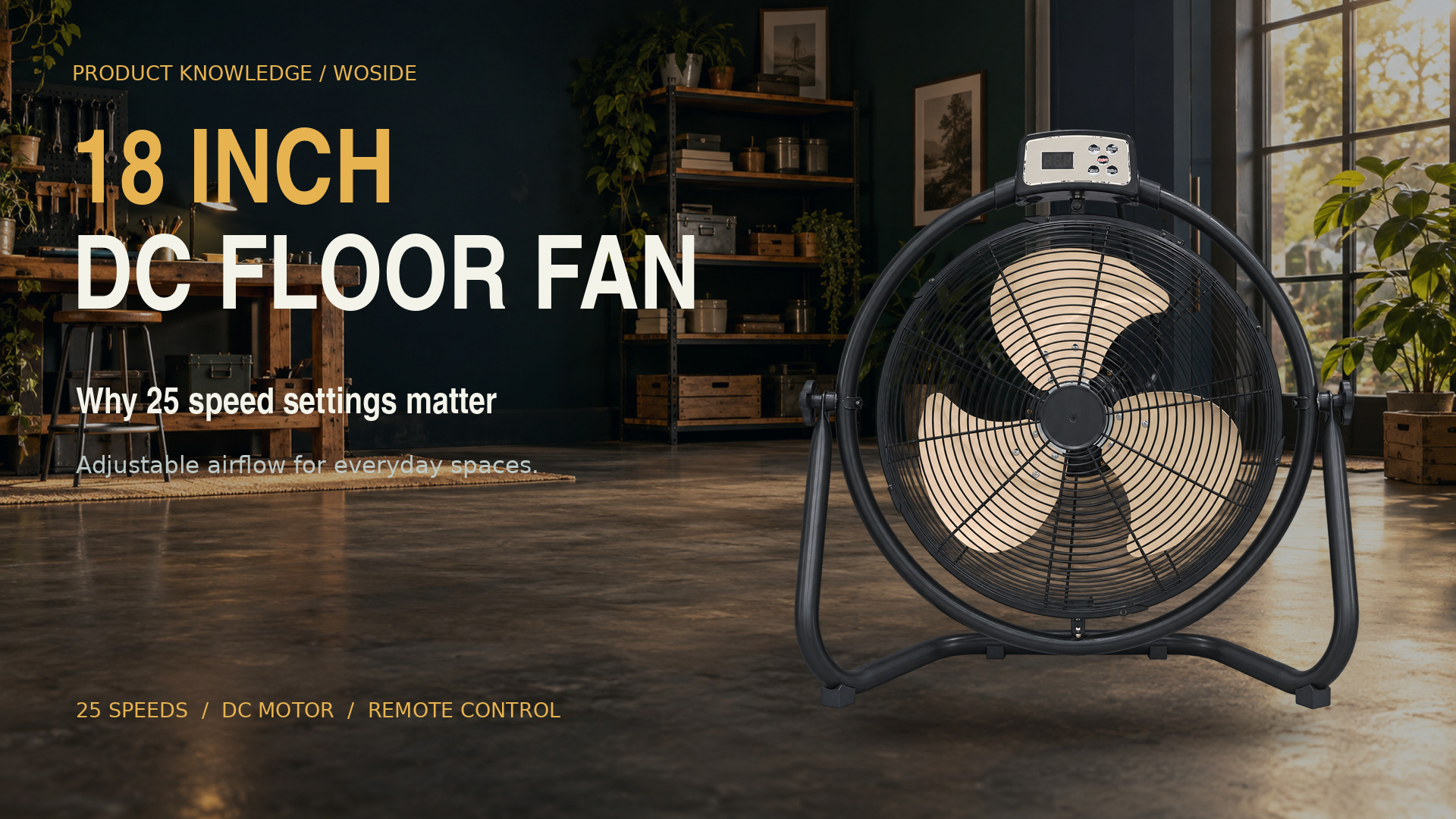
Ein 18 inch floor fan with a DC inverter motor can offer 25 speed levels, allowing users to adjust airflow more precisely instead of choosing between only three fixed settings. Woside’s current platform combines approximately 90W input power, air speed up to 9 m/s, 45–66 dB operating noise across its speed range and an infrared remote control, making it a practical remote control floor fan for buyers who want finer adjustment. The DC motor does not automatically guarantee a fixed percentage of energy savings; actual consumption depends on the selected speed and operating hours. Its commercial value is flexible control.

Where Does This Product Fit in the U.S. Market?
Searches for an industrial floor fan OEM often include very different products. Some buyers need fully enclosed motors, reinforced guards or certified equipment for factories and construction sites. A standard inverter floor fan should not be marketed as a heavy-duty industrial unit unless its materials, motor protection and testing support that claim.
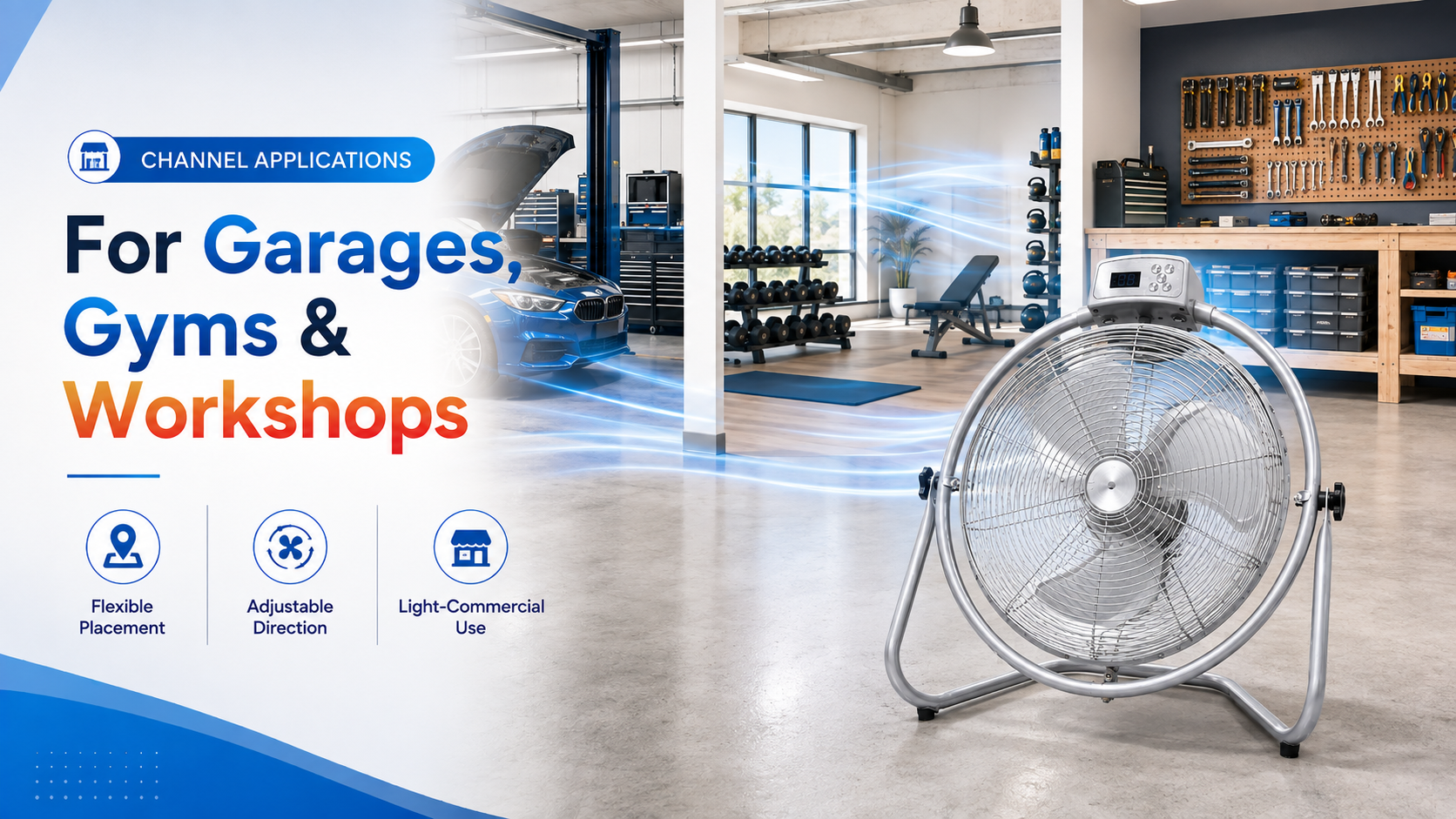
Its strongest position is light-commercial and prosumer distribution: automotive garages, fitness studios, workshops, patios, photography spaces, hardware stores and large residential rooms. The frame provides 180-degree left-right oscillation, while the fan head can be manually tilted through 360 degrees. Floor placement and optional wall mounting allow one SKU to serve several merchandising scenarios.
This is where an energy efficient floor fan can become a premium alternative to commodity three-speed models—not by replacing every industrial fan, but by offering finer airflow control, quieter low-speed operation and remote convenience.
What Should Importers Include in an OEM RFQ?
Before requesting prices from a 25 speed floor fan manufacturer, distributors should define the electrical version, desired airflow test method, noise test distance, cord and plug requirements, control-panel language, packaging strength and spare-parts plan. For the U.S. market, the RFQ should also confirm 120V/60Hz configuration and the safety or retailer testing requirements applicable to the intended sales channel.
Infrared remote-control reliability deserves separate attention. Because an infrared handset depends on line-of-sight to the receiver, buyers should confirm operating range, receiving angle, response under bright indoor lighting, battery type and button durability. The infrared receiver on the control panel should also remain unobstructed during operation. Packaging drop tests are important because the circular metal frame and control panel must remain aligned after parcel or pallet transport.
A More Defensible 2027 Product Position
OSHA’s federal heat-injury rule remains a proposal, not a final standard, but its rulemaking record keeps indoor and outdoor workplace heat on the agenda. Distributors should therefore sell the fan as one part of a broader heat-management plan, not as a substitute for ventilation, hydration or required workplace controls.
For importers already selling fans, the clearest opportunity is a differentiated 18-inch model between basic retail fans and heavy industrial circulators. OEM options for voltage, plug, packaging, color, branding and control layout can help regional distributors build a recognizable product line instead of competing only on price. That positioning can also help wholesalers defend higher margins when retail buyers compare products that otherwise appear similar in blade size and metal construction. Buyers planning the 2027 cooling season should complete samples, performance checks and packaging validation before placing seasonal production orders.
Diesen Artikel teilen

Verfasst von: Jamie Chen
Inhalt des Beitrags
Folgen Sie uns
Neueste Artikel
Oktober 12, 2026
Oktober 12, 2026