Guide d'approvisionnement en refroidisseurs d'air par évaporation : 4 risques cachés liés à la qualité que les acheteurs B2B doivent éviter

Alors que les températures estivales mondiales ne cessent de battre des records, la demande [...]
Alors que les températures estivales mondiales ne cessent de battre des records, la demande en solutions de climatisation économes en énergie a explosé. Pour les acheteurs B2B, les importateurs d'appareils électroménagers et les chaînes de supermarchés, l'approvisionnement en gros Refroidisseurs d'air par évaporation est un investissement saisonnier très rentable.
Cependant, le marché des appareils B2B est en proie à des guerres de prix, ce qui conduit de nombreux fabricants bas de gamme à rogner sur les coûts. Un prix unitaire initial plus bas se traduit souvent par des taux de retour catastrophiquement élevés, des rappels de produits coûteux et une atteinte à la réputation de la marque.
Pour protéger votre investissement professionnel, voici un guide d'achat de qualité, rédigé par des experts, qui passe en revue les quatre composants essentiels d'un refroidisseur d'air par évaporation et vous explique comment vous assurer que vous achetez un produit offrant une fiabilité de niveau professionnel.
1. Le moteur : cuivre pur ou aluminium recouvert de cuivre (CCA)
Le moteur est le cœur d'un ventilateur. Il détermine la durée de vie, la vitesse du vent et, surtout, la sécurité de l'appareil.
Le risque caché :
Pour réduire les coûts, de nombreux fabricants de produits bas de gamme ont recours à Aluminium recouvert de cuivre (CCA) moteurs à fil. L'aluminium présente une résistance électrique supérieure à celle du cuivre, ce qui entraîne une surchauffe rapide du moteur lorsqu'il est soumis à des charges de travail continues en été. Les moteurs CCA s'usent rapidement, ce qui peut entraîner une panne soudaine du ventilateur ou la fusion des bornes en l'espace d'une seule saison.
La norme professionnelle :
Insistez toujours pour que Moteurs à bobinage en fil de cuivre pur 100%. Le cuivre pur offre une conductivité électrique supérieure, une consommation d'énergie réduite, un niveau sonore de fonctionnement plus faible et une durée de vie nettement plus longue.
La solution ultime en matière de sécurité : les protecteurs thermiques mécaniques
Un fabricant haut de gamme va encore plus loin en matière de sécurité des moteurs en mettant en place plusieurs niveaux de protection fondés sur les principes de la physique. Les moteurs de qualité doivent être équipés d'un système intégré protecteur thermique mécanique intégré (protecteur contre les surcharges thermiques) niché au plus profond des enroulements du stator.
Comment ça marche : Si les pales du ventilateur se bloquent accidentellement à cause de débris (blocage du rotor) ou si elles fonctionnent en continu dans un environnement extrêmement chaud, la température interne du moteur va monter en flèche. Dès qu’elle atteint un seuil critique (généralement de 130 °C à 135 °C), la bande bimétallique située à l'intérieur de ce composant mécanique s'ouvre brusquement sous l'effet de la dilatation thermique, couper immédiatement l'alimentation électrique avant que tout risque de fumée ou d'incendie ne puisse se manifester. Une fois que le moteur a refroidi jusqu'à atteindre une température sûre, le disjoncteur mécanique se réinitialise automatiquement et rétablit le fonctionnement.
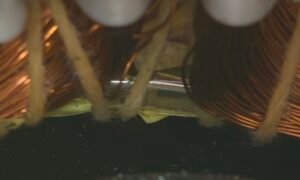
Zoom sur la norme de sécurité ultime : un gros plan macro du protecteur thermique mécanique métallique intégré, dissimulé à l'intérieur des bobines. Ce composant essentiel coupe physiquement l'alimentation dès que la chaleur interne dépasse les seuils de sécurité, protégeant ainsi votre marque contre les responsabilités coûteuses liées aux défaillances des produits.
Comment les acheteurs B2B peuvent-ils vérifier :
- Consultez les fiches techniques : Vérifier dans les documents reçus si les matériaux utilisés pour le bobinage des moteurs sont explicitement mentionnés, et vérifier des termes tels que “ Protection thermique incluse ” ainsi que les indices d'isolation normalisés (par exemple, classe B ou classe F).
- Demander un rapport d'essai de rotor bloqué en usine : Exigez du fabricant qu'il vous communique les données de laboratoire. Un moteur bon marché et de qualité inférieure va fumer et prendre feu en quelques minutes s'il est bloqué mécaniquement ; un moteur de qualité professionnelle déclenchera son disjoncteur thermique en toute sécurité, laissant la structure du moteur entièrement intacte une fois refroidi.
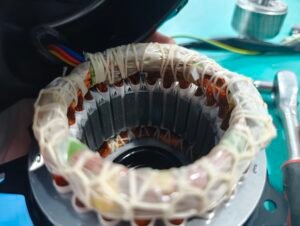
Un aperçu de notre processus de fabrication interne rigoureux : chaque moteur de ventilateur de refroidissement Woside est doté d'un enroulement épuré en fil de cuivre pur 100% à haute densité, conçu pour minimiser les pertes de puissance et optimiser la durée de vie thermique.
2. Le boîtier : plastique vierge 100% ou matériau recyclé ?
Le boîtier extérieur protège les composants électriques internes et détermine la première impression esthétique que le consommateur se fait de votre marque lorsqu'il la voit en rayon.
Le risque caché :
Les climatiseurs d'entrée de gamme utilisent souvent résine de plastique issue de déchets recyclés. Le plastique recyclé dégage une odeur chimique caractéristique et âcre lorsque le ventilateur fait circuler de l'air chaud à travers le châssis — ce qui constitue l'une des principales causes de retour immédiat des produits par les consommateurs. De plus, la résine recyclée présente une très faible résistance aux UV et une intégrité structurelle fragile. Exposé au soleil estival, le boîtier peut rapidement se décolorer, se déformer, se fissurer ou se briser lors de transports maritimes intensifs et de la distribution nationale par palettes.
La norme professionnelle :
Les refroidisseurs d'air haut de gamme utilisent exclusivement 100% : plastiques techniques vierges ABS ou PP (polypropylène). Le matériau vierge est structurellement résistant, offre une excellente résistance aux chocs, est totalement inodore et conserve sa finition lisse et brillante de grande qualité ainsi que la stabilité de ses couleurs même après des années d'exposition aux intempéries.
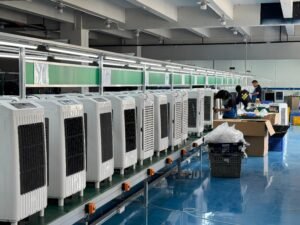
L'utilisation de plastiques techniques ABS/PP vierges 100% garantit une expérience utilisateur totalement inodore, une solidité des couleurs éclatante et une grande résistance aux chocs structurels pendant le transport.
3. Le réseau d'eau : ingénierie des fuites et protection contre la combustion à sec
Les refroidisseurs d'air par évaporation reposent entièrement sur une circulation continue de l'eau. Une conception inadéquate de la dynamique des fluides est un véritable cauchemar pour les importateurs étrangers.
Le risque caché
Les fuites d’eau provenant de joints en plastique de mauvaise qualité, de soudures défectueuses ou de bouchons de vidange mal fixés peuvent rapidement endommager les parquets en bois massif des particuliers, ce qui peut entraîner des réclamations coûteuses en matière de responsabilité civile à l’encontre de votre marque de distribution. De plus, si les consommateurs oublient de remplir le réservoir d'eau, les pompes à eau standard à bas prix continueront de fonctionner à sec (fonctionnement à sec), ce qui entraînera la destruction complète du sous-ensemble de la pompe en quelques heures.
La norme professionnelle
Collaborez avec des fabricants qui mettent en œuvre une méthodologie d'ingénierie à deux volets pour le confinement des fluides :
-
Réservoirs d'eau moulés d'un seul tenant : La suppression des joints de construction situés sous la ligne de flottaison réduit au minimum le risque physique de fuites.
-
Arrêt automatique / Protection par capteur de fonctionnement à sec : Le système doit être équipé d'un flotteur ou d'un capteur de niveau d'eau intégré. Dès que le niveau d'eau passe en dessous du seuil minimum de sécurité, le système coupe automatiquement l'alimentation électrique de la pompe à eau tout en laissant le ventilateur en marche, ce qui protège la pompe contre les pannes dues à un fonctionnement à sec.
4. Le tampon de refroidissement : nid d'abeille haute densité ou papier de qualité inférieure ?
Le tampon de refroidissement (milieu d'évaporation) détermine directement la baisse de température réelle que l'appareil peut atteindre.
Le risque caché
Les supports de refroidissement bon marché sont constitués de papier fin à mailles lâches, assemblés à l'aide de colles industrielles au formaldéhyde peu coûteuses. Une fois mouillés, ils dégagent des odeurs chimiques dangereuses et se dégradent ou s'affaissent en l'espace de quelques mois. En raison de leur faible capacité de rétention d'eau, l'air qui en sort est humide et étouffant, loin d'être rafraîchissant.
La norme professionnelle
Optez pour des, Panneaux de refroidissement en nid d'abeille haute densité (tels que les modèles structurels 5090 ou 7090). Ces plaques sont dotées d'une structure épaisse à ondulations croisées qui optimise la surface de contact entre l'air en mouvement et l'eau en circulation, offrant ainsi une efficacité de refroidissement exceptionnelle. Assemblées à l'aide de résines écologiques et inodores, elles conservent leur intégrité structurelle et résistent à la moisissure même après des années de cycles d'humidification et de séchage.
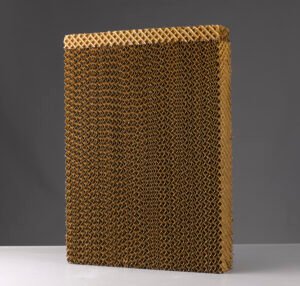
Conçu pour une baisse maximale de la température : gros plan sur notre tampon de refroidissement haut de gamme en nid d’abeille 5090, d’une épaisseur importante. Cette structure spécifique à haute densité optimise l’efficacité de l’évaporation de l’eau dans l’air, ce qui se traduit par une baisse rapide et notable de la température, tout en restant totalement inodore et résistant à la moisissure.
Conclusion : collaborez avec un fabricant qui privilégie l'ingénierie plutôt que la réduction des prix
Sur le marché très concurrentiel des appareils électroménagers saisonniers, économiser quelques dollars sur le prix unitaire d'un appareil moins cher peut vous coûter des dizaines de milliers de dollars en mesures correctives. S'associer à une usine qui dispose de ses propres moules, maîtrise sa chaîne d'approvisionnement en matières premières et applique des protocoles stricts de contrôle qualité (CQ) est le seul moyen de développer une gamme de produits durable et rentable.
À WOSIDE, avec le soutien de Plus de 27 ans d'expertise dans la fabrication de produits haut de gamme, nous respectons scrupuleusement les normes de production B2B les plus strictes. Nous mettons en œuvre des contrôles rigoureux des nouveaux matériaux selon la méthode 100%, et nos équipes d'ingénieurs internes assurent une personnalisation complète en mode OEM/ODM (logos personnalisés, moules sur mesure et conception d'emballages). Chaque composant de moteur entrant est soumis à un double contrôle et vérifié par notre équipe IQC (contrôle qualité à la réception) afin de garantir une conformité totale aux normes de sécurité avant l’assemblage en série.
Assurez votre approvisionnement estival en toute confiance
Envisagez-vous de lancer votre prochaine gamme de produits saisonniers ou souhaitez-vous réaliser un audit de votre chaîne d'approvisionnement actuelle en appareils électroménagers ?
[Contactez dès aujourd'hui l'équipe d'experts de WOSIDE] pour demander un devis direct auprès de l'usine, un catalogue complet de produits ou pour organiser l'envoi immédiat d'échantillons OEM/ODM. Laissez-nous vous aider à développer une gamme d'appareils électroménagers compétitive et hautement fiable, qui inspirera confiance à votre marché.
Partager cet article

Écrit par : Jamie Chen
contenu de l'article
Suivez-nous
Derniers articles
octobre 12, 2026
octobre 12, 2026