Guida alla personalizzazione OEM/ODM dei raffreddatori d'aria domestici

For importers, wholesalers, distributors and private label brands, a household [...]
For importers, wholesalers, distributors and private label brands, a household air cooler is not only a standard seasonal appliance. It can also be customized for different markets, sales channels, climates, voltage standards, packaging languages and brand positioning.
A professional Produttore OEM di raffreddatori d'aria domestici factory or air cooler ODM supplier can help buyers customize product appearance, logo, color, packaging, plug type, voltage, control panel, function configuration and product line strategy. In some projects, deeper customization may also involve plastic mold modification or new product development.
This guide explains what can be customized in a household air cooler OEM/ODM project, which customization options are easier to confirm, and which changes may require engineering evaluation before mass production.
1. What Is a Household Air Cooler OEM/ODM Project?
A household air cooler OEM/ODM project means that a factory manufactures evaporative air coolers according to the buyer’s brand, target market and product requirements.
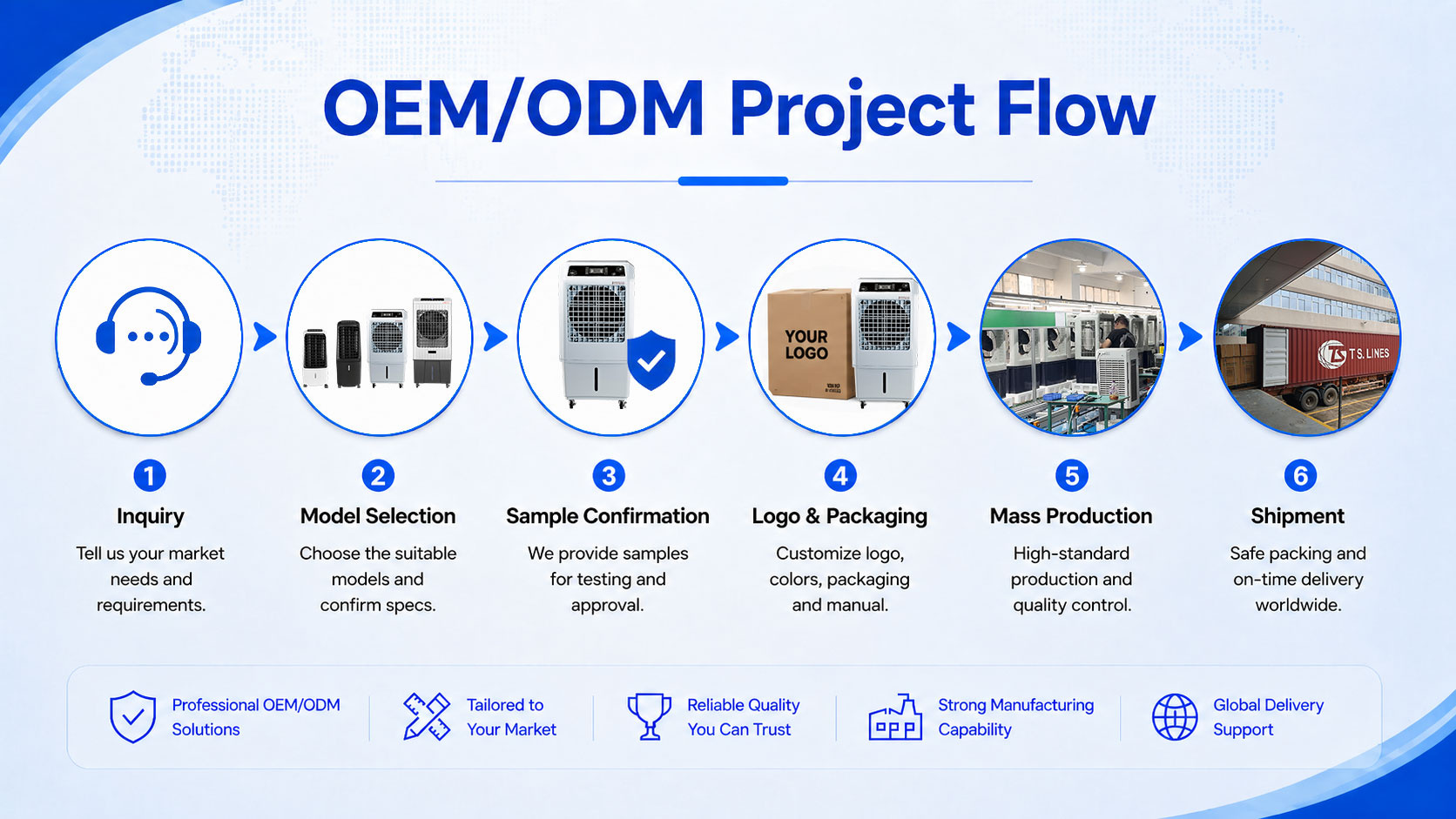
In an OEM air cooler project, the buyer usually already has a brand, product concept, target price range or reference model. The factory helps produce the product with customized logo, color, packaging, plug, voltage, labels and other details.
In an ODM air cooler project, the buyer may not have a complete product design. The factory provides existing model platforms, engineering support, structural solutions and available customization options to help the buyer build a product line faster.
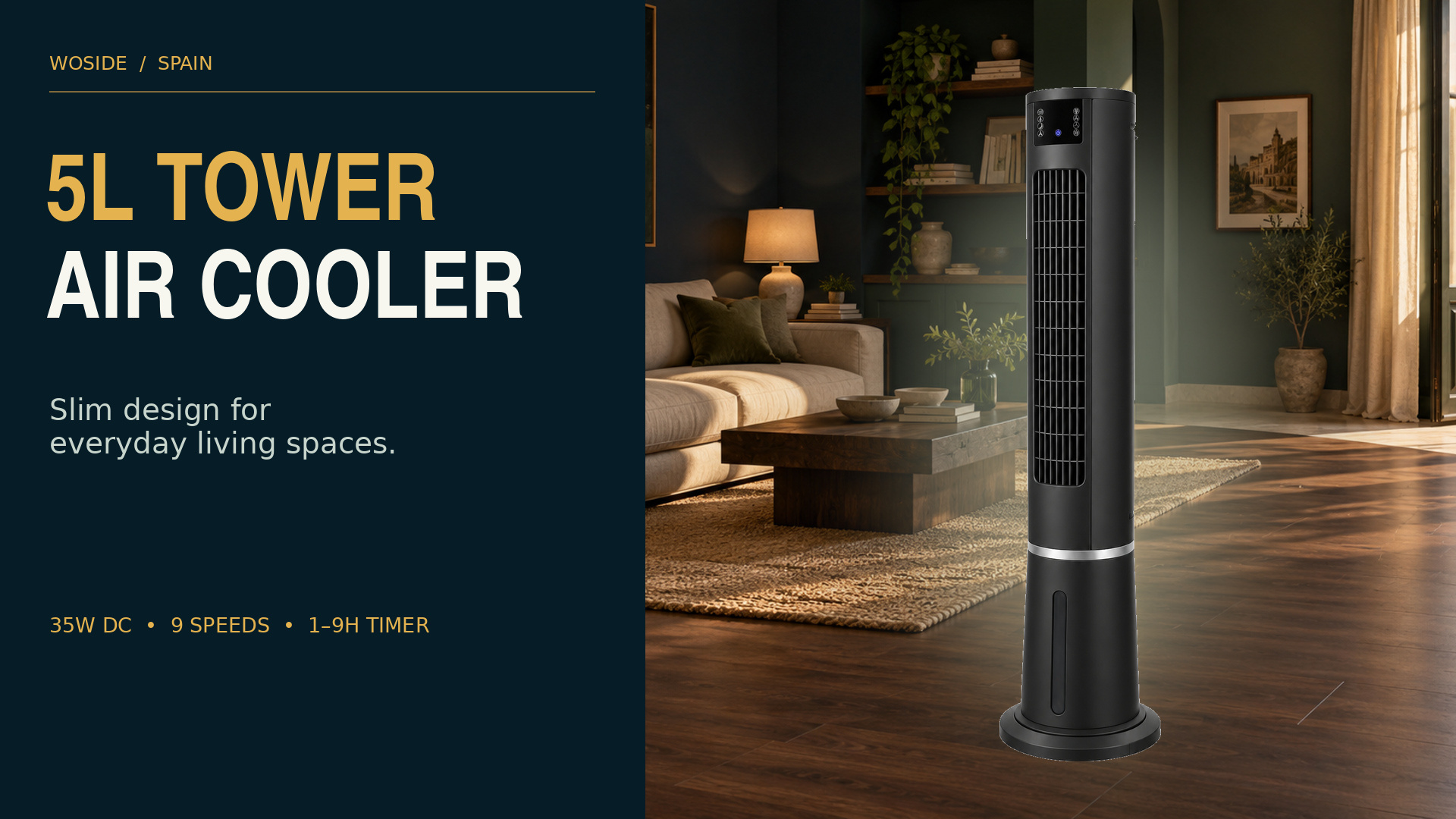
For household and light commercial applications, most buyers focus on portable air coolers in the 8L–45L range. These models are suitable for homes, offices, restaurants, small shops, gyms and other indoor or semi-indoor spaces.
They are different from large industrial evaporative coolers used in warehouses, workshops or construction sites. Household air coolers focus more on indoor comfort, appearance, mobility, user-friendly operation and retail packaging.
2. Why Customization Matters for Wholesale Buyers
Different markets do not sell air coolers in exactly the same way.
A model that works well for a home appliance retailer in Spain may need different packaging language, color tone and plug configuration for the UAE market. A product for the United States may need 110V–120V configuration and a US plug. A Turkish distributor may care more about cost control, carton strength and fast seasonal delivery.
For B2B buyers, customization is not only about making the product look different. It helps solve practical sourcing and sales problems, such as:
- Matching local voltage and plug standards
- Building private label brand identity
- Improving retail shelf presentation
- Reducing customer complaints caused by unclear instructions
- Adjusting product features for local climate and usage habits
- Differentiating from competitors using similar air cooler models
- Preparing products for supermarket, e-commerce or distributor channels
A reliable portable air cooler OEM factory should help buyers turn market requirements into clear, production-ready specifications.
3. Common OEM/ODM Customization Options
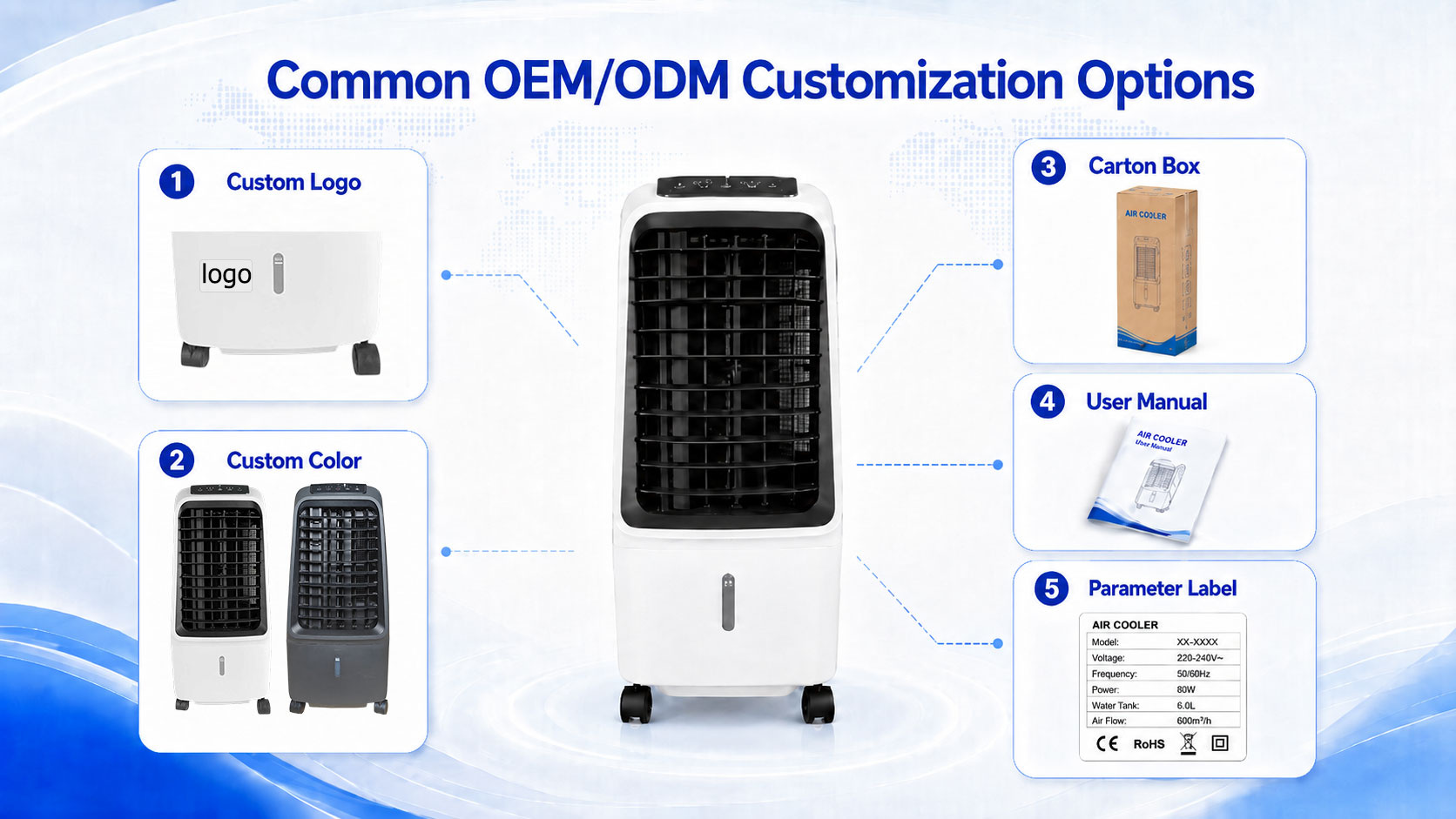
Most household air cooler OEM projects begin with standard customization. These items are usually easier to confirm and do not require major structural changes.
Common customization options include logo, color, packaging, manual language, plug type, voltage, rating label, carton design and available function combinations.
| Customization Item | Common Options | Buyer Value |
|---|---|---|
| Logo | Product body, control panel, carton, manual, rating label | Builds private label identity |
| Color | Body color, grille color, panel color, decorative parts | Matches local design preference |
| Packaging | Brown carton, color box, private label carton | Supports retail and wholesale channels |
| Manual language | English, Spanish, Arabic, Turkish or other languages | Reduces user confusion and after-sales issues |
| Plug and voltage | US plug, EU plug, UK plug, 110V, 220V–240V | Matches local market requirements |
| Product label | Rating label, warning label, importer information | Supports traceability and local sales preparation |
| Function combination | Timer, remote control, swing, cooling mode, fan speed | Builds different price levels |
| Control panel | Mechanical knob, touch panel, LED display | Improves product value and user experience |
For new buyers, these standard customization options are usually the most practical starting point. They allow the buyer to launch a branded air cooler product line without investing in private mold development from the beginning.
4. Control Panel and Function Customization
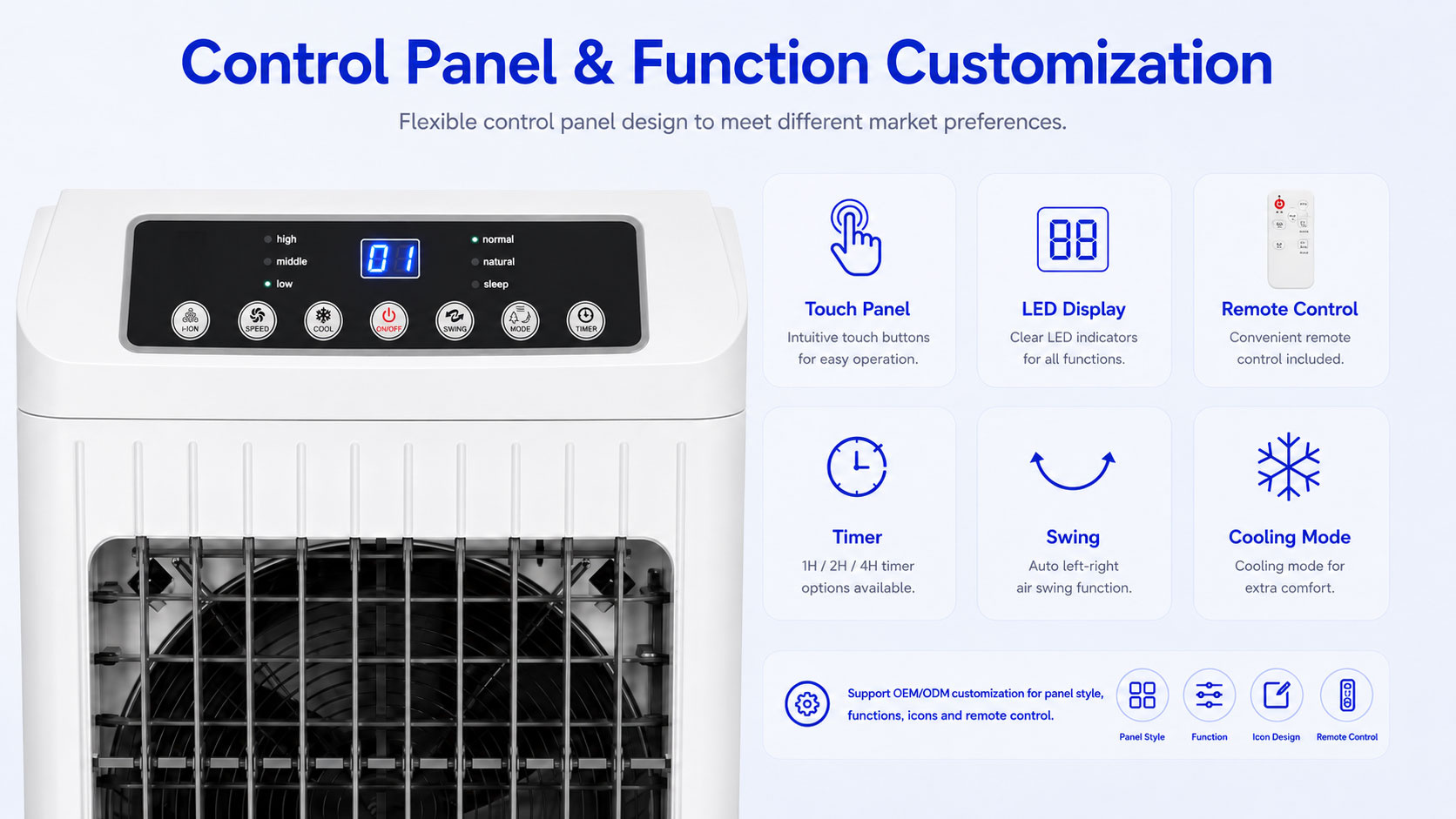
The control panel is one of the most visible parts of a household air cooler. It directly affects the user experience and the perceived value of the product.
Depending on the model platform, buyers may customize or select different control options, such as:
- Mechanical knob control
- Touch control panel
- LED display
- Telecomando
- Funzione timer
- Oscillation control
- Cooling mode
- Fan speed levels
- Sleep mode
- Natural wind mode
- Low-water indicator
- Water pump control
Entry-level models may use simple mechanical controls to reduce cost. Mid-range and premium models often use touch panels, LED displays and remote controls to improve retail value.
For supermarket and e-commerce buyers, clear function icons and easy-to-understand panel design are important. A good control panel should not only look modern but also reduce user confusion after purchase.
However, control panel customization should always be checked against the existing model structure. A new panel layout, larger display or different button position may affect the plastic panel, PCB layout, internal space and assembly process.
5. Not Every Function Can Be Added to Every Existing Model
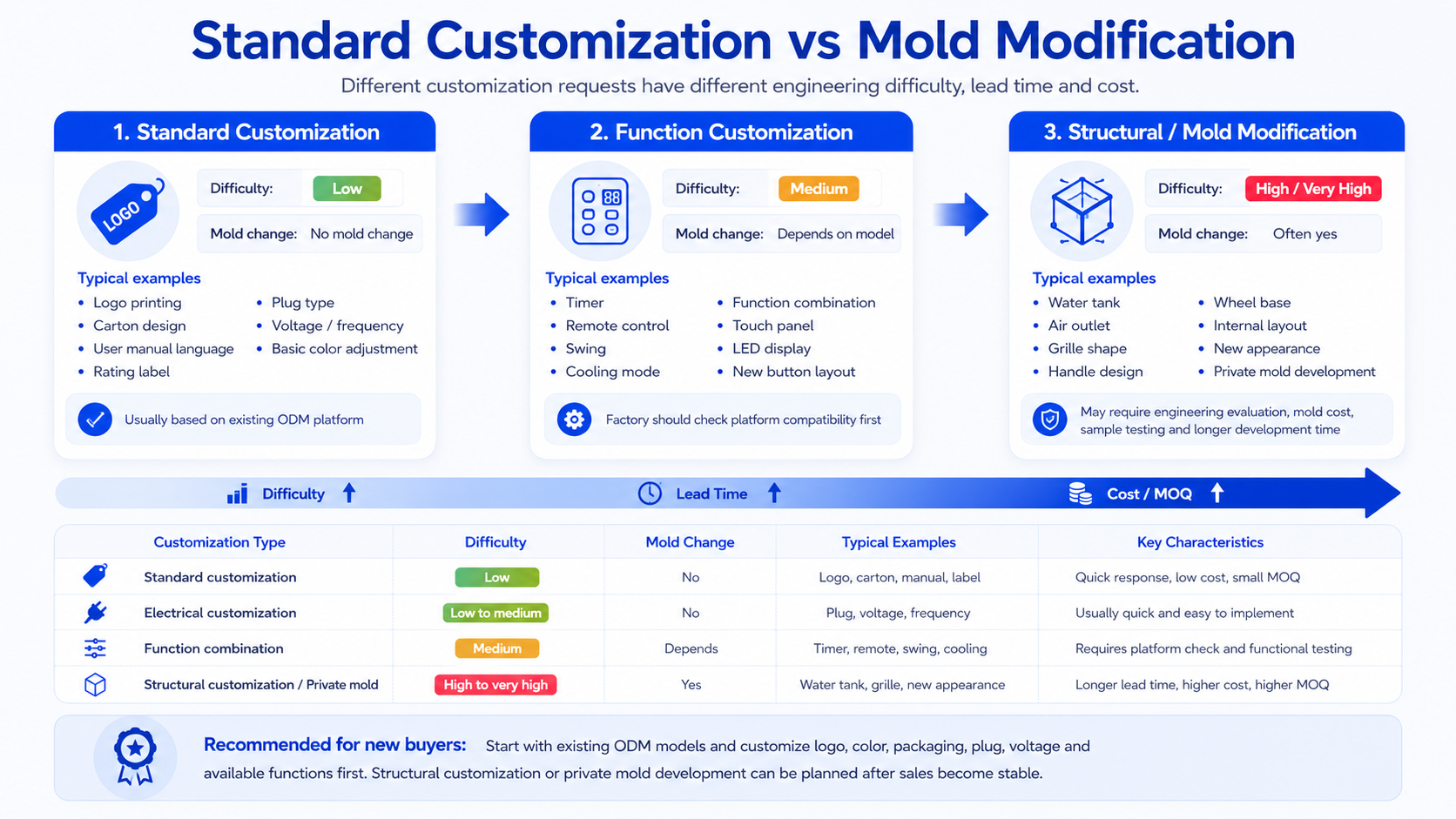
In a household air cooler OEM/ODM project, buyers should understand that different customization items have different levels of difficulty. Some changes can be completed based on an existing ODM platform, while other changes may require plastic mold modification, internal structure adjustment or even new mold development.
Simple customization usually includes logo printing, carton design, user manual language, rating label, plug type, voltage configuration and basic color adjustment. These items are normally easier to evaluate and faster to confirm before mass production.
However, some functional upgrades may not be available for every existing model. For example, adding a larger LED display, changing a mechanical knob into a touch control panel, adjusting the air outlet structure, modifying the water tank, adding a new handle design or changing the grille shape may affect the product’s plastic parts, internal space, airflow structure and assembly process.
For this reason, a professional household air cooler OEM factory will first check whether the requested function can be supported by the current model platform. If the change affects plastic molds, control panel openings, water tank structure, air duct design or internal component layout, the factory may need to provide a separate engineering evaluation.
Structural customization may require a higher MOQ, longer development time, mold cost, sample testing and additional confirmation before mass production. This does not mean the customization is impossible. It means the project should be treated as product development instead of simple standard customization.
| Customization Type | Difficulty Level | Mold Change Needed? | Typical Examples |
|---|---|---|---|
| Standard customization | Low | No | Logo, carton, manual, rating label |
| Electrical customization | Low to medium | No | Plug, voltage, frequency, power label |
| Color customization | Medium | Usually no | Body color, grille color, panel color |
| Function combination | Medium | Depends on model | Timer, remote control, swing, cooling mode |
| Control panel redesign | Medium to high | Sometimes | Touch panel, LED display, new button layout |
| Structural customization | High | Often yes | Water tank, air outlet, grille, handle, wheel base |
| Private mold development | Very high | Sì | New appearance, exclusive model design |
For new buyers, it is often more practical to start with existing ODM models and customize logo, color, packaging, plug, voltage and available function combinations first. After sales volume becomes stable, deeper structural customization or private mold development can be planned for the next stage.
6. Product Line Customization: 8L–45L Air Coolers
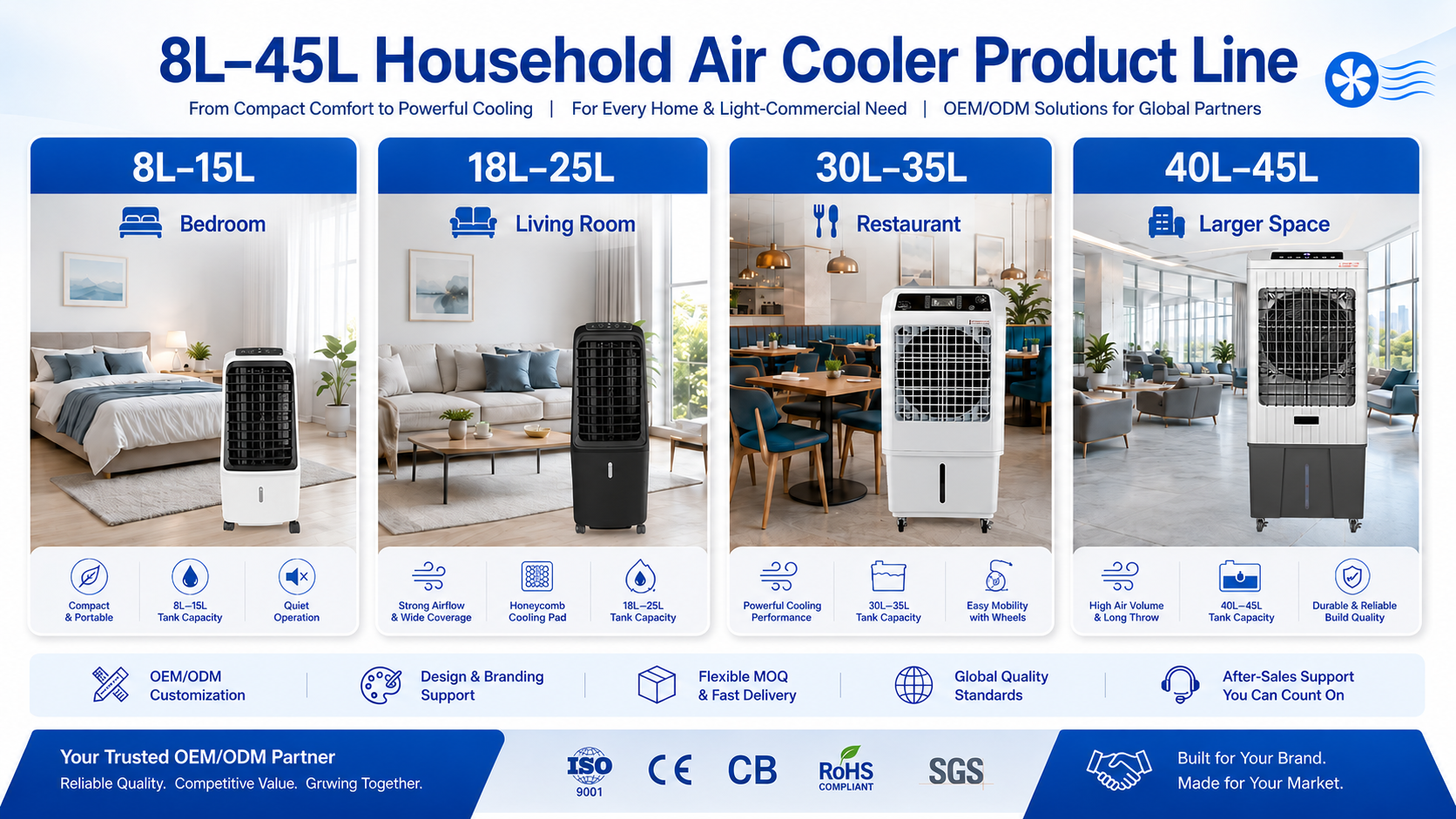
Household air cooler buyers usually do not purchase only one model. A complete product line can help cover different price ranges, room sizes, retail channels and usage scenarios.
For household and light commercial applications, common capacity ranges include:
- 8L–15L air coolers for bedrooms, small rooms and compact apartments
- 18L–25L air coolers for living rooms, home offices and small shops
- 30L–35L air coolers for restaurants, gyms and retail stores
- 40L–45L air coolers for larger rooms, hot dry markets and longer operation needs
For wholesale buyers, the best product line usually includes at least two or three capacity levels. This allows the buyer to serve different customer budgets and sales channels.
For example, an importer may use 20L–25L models as the main retail product, 8L–15L models for entry-level promotion, and 30L–45L models for hot dry markets or light commercial use.
A professional custom air cooler manufacturer should help buyers choose the right capacity range based on the target market, price positioning, expected order quantity and sales channel.
7. Market-Specific Suggestions for USA, Spain, UAE and Brazil
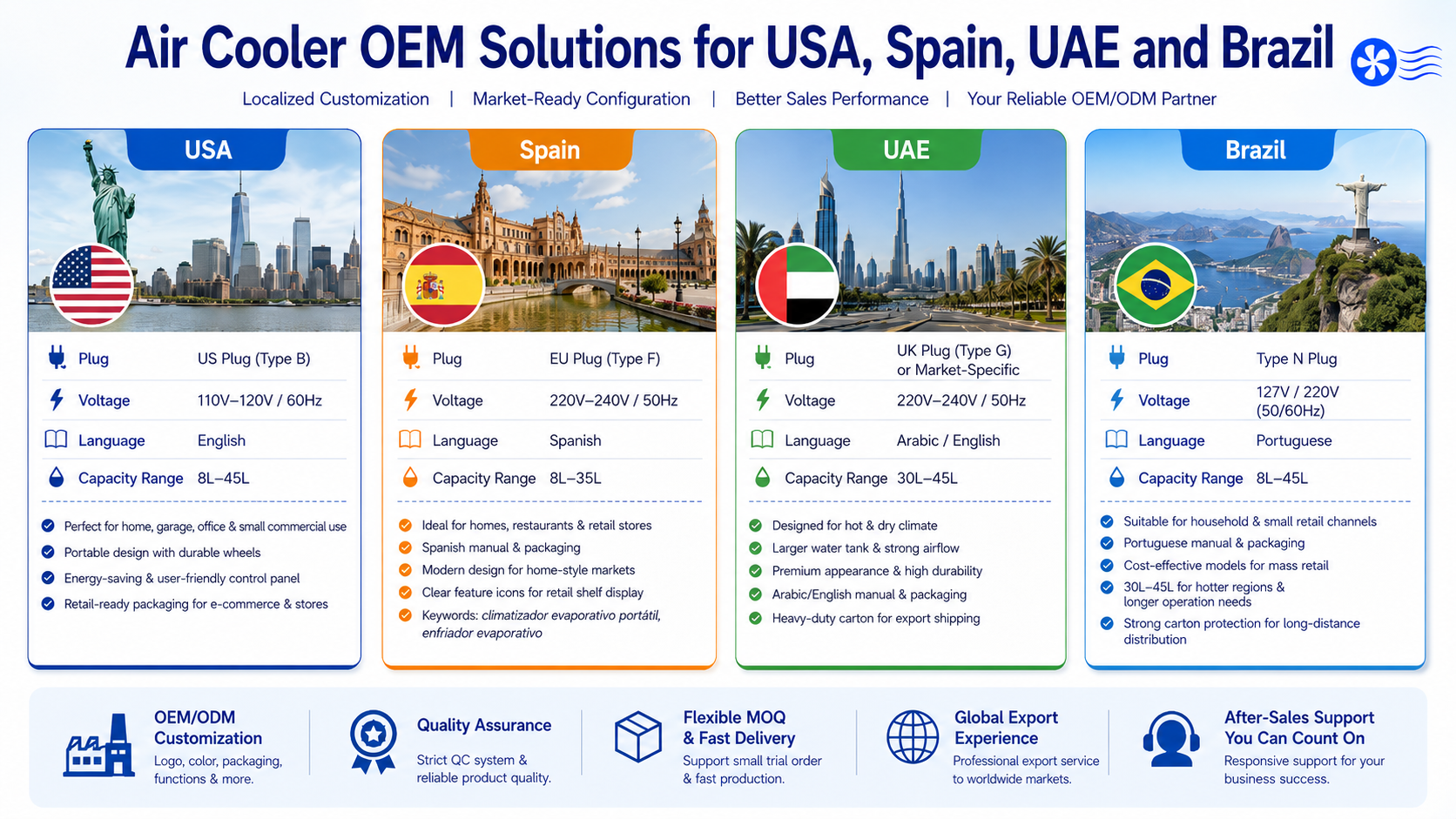
Different markets may require different product configurations. For importers and distributors, market-specific customization can improve product acceptance and reduce sales friction.
USA Market
For the United States, buyers often focus on household, garage, office and small commercial scenarios.
Recommended customization points include:
- 110V–120V configuration
- spina americana
- Clear English packaging
- Strong selling points around portability and energy-saving use
- Durable wheels for home and garage movement
- User-friendly control panel
- Retail-ready carton design
Spain Market
For Spain, buyers may consider models for homes, restaurants, retail stores and summer seasonal sales.
Recommended customization points include:
- presa UE
- Manuale in spagnolo
- Spanish packaging text
- Compact and medium-capacity models
- Modern home-style color design
- Retail shelf packaging
- Clear product feature icons
Spanish keywords such as “climatizador evaporativo portátil” and “enfriador evaporativo” can also be considered in packaging, product listings and marketing materials.
UAE Market
For the UAE and Middle East markets, buyers often need products suitable for hot and dry environments, offices, shops and residential spaces.
Recommended customization points include:
- 220V–240V configuration
- UK plug or market-specific plug
- Arabic/English manual and packaging
- Larger water tank options
- Strong airflow configuration
- Premium appearance design
- Strong carton protection for export shipping
For this market, 30L–45L models may be suitable for buyers who want longer operation time and stronger cooling performance.
Brazil Market
For Brazil and other South American markets, buyers may focus on household cooling, small retail stores, home appliance distribution and seasonal summer sales.
Recommended customization points include:
- Type N plug configuration
- 127V / 220V electrical options depending on the target sales region
- Portuguese manual and packaging
- Cost-effective household models for mass retail channels
- 18L–30L mainstream household models
- Larger 30L–45L options for hotter regions and longer operation needs
- Strong carton protection for long-distance distribution
- Clean appearance suitable for home and small commercial use
For Brazil, a balanced product line with localized language, suitable plug configuration and flexible capacity options can help importers and distributors serve different regional markets more effectively.
8. OEM/ODM Buyer Checklist
Before starting a household air cooler OEM project, buyers should prepare clear specifications. This helps reduce communication time and avoid production mistakes.
A practical OEM/ODM inquiry should include:
- Target country or region
- Estimated order quantity
- Required water tank capacity
- Voltage and plug type
- Required certifications
- Logo position
- Product color
- Control panel requirements
- Remote control requirement
- Packaging type
- Manual language
- Carton marking
- Target retail channel
- Expected delivery time
- Sample requirement
- Quality inspection requirement
Before confirming a bulk order, buyers should also check:
- Whether the selected model supports the requested functions
- Whether structural changes require mold modification
- Whether MOQ changes after customization
- Whether sample testing is required before mass production
- Whether packaging and labels match the target market
- Whether carton size and loading quantity are acceptable
- Whether spare parts and after-sales support are available
The more specific the buyer’s requirement is, the easier it is for the factory to recommend the right model, quotation and production plan.
FAQ
What can be customized in a household air cooler OEM project?
Common customization options include logo, color, packaging, manual language, plug type, voltage, rating label, control panel and available function combinations. Some projects may also include structural customization or private mold development.
Can I customize logo, color and packaging?
Yes. Logo, body color, grille color, carton design, color box, manual and rating label are common customization items in household air cooler OEM projects. These are usually easier to confirm than structural changes.
Can I customize plug and voltage for different countries?
Yes. Plug and voltage customization is important for export orders. Buyers should clearly confirm the target country, voltage, frequency and plug type before production.
Can every function be added to an existing household air cooler model?
Not always. Some functions can be added based on the existing model platform, while others may require changes to plastic molds, control panel openings, water tank structure, airflow design or internal component layout. The factory should evaluate the feasibility before confirming production.
Is private mold development necessary?
Not always. For many buyers, existing ODM models with customized logo, color, packaging, plug and available function combinations are enough to start sales. Private mold development is more suitable for established brands or large-volume buyers who need exclusive product design.
Which air cooler capacity is best for wholesale buyers?
For household and light commercial use, common options include 8L–15L, 18L–25L, 30L–35L and 40L–45L. The best choice depends on the target market, retail price range, climate, usage scenario and sales channel.
Conclusione
A household air cooler OEM/ODM project is more than simple logo printing. For B2B buyers, customization can include product appearance, color, packaging, manual language, plug, voltage, control panel, function configuration, product line planning and even mold-related development.
However, not every function can be added directly to every existing model. Some changes are standard customization, while others require engineering evaluation, mold modification, sample testing and additional production confirmation.
For importers, wholesalers and private label brands, the right customization strategy should match the target market, sales channel, budget and product positioning.
Whether the market is the United States, Spain, UAE or Turkey, a professional household air cooler OEM factory can help buyers build a more competitive product line with the right capacity, function, packaging and branding solution.
Condividi questo articolo

Scritto da: Jamie Chen
contenuto del post
Seguiteci
Articoli più recenti
Ottobre 7, 2026
Ottobre 7, 2026