Air Cooler Principle and Produce Process

Introduction An air cooler, also known as an evaporative air [...]
Introduction
An air cooler, also known as an evaporative air cooler or eco-friendly cooling unit, works through the natural principle of water evaporation and heat absorption. It does not require a compressor or refrigerant, making it an energy-saving cooling solution with ventilation, dust reduction and air exchange functions.
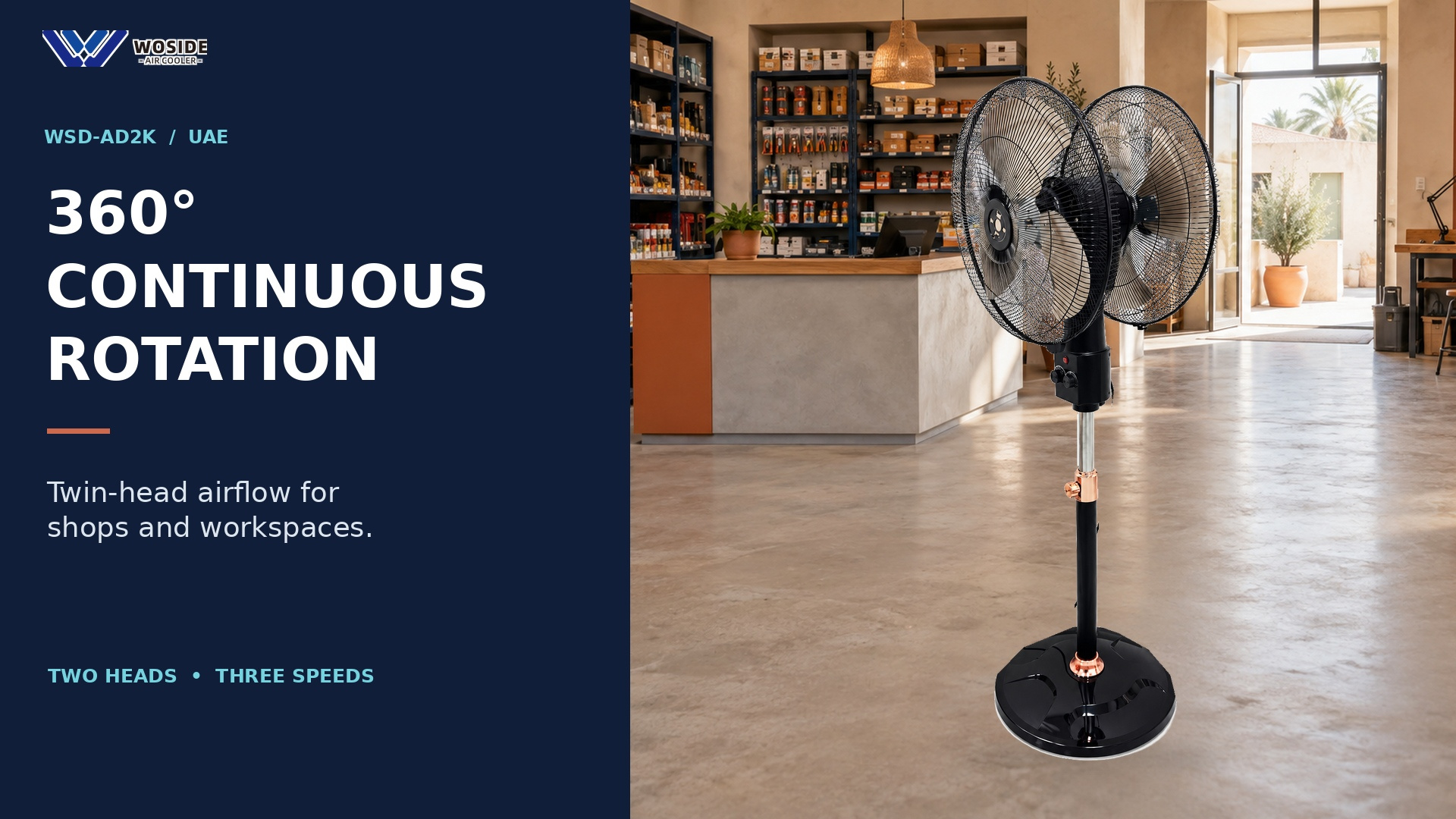
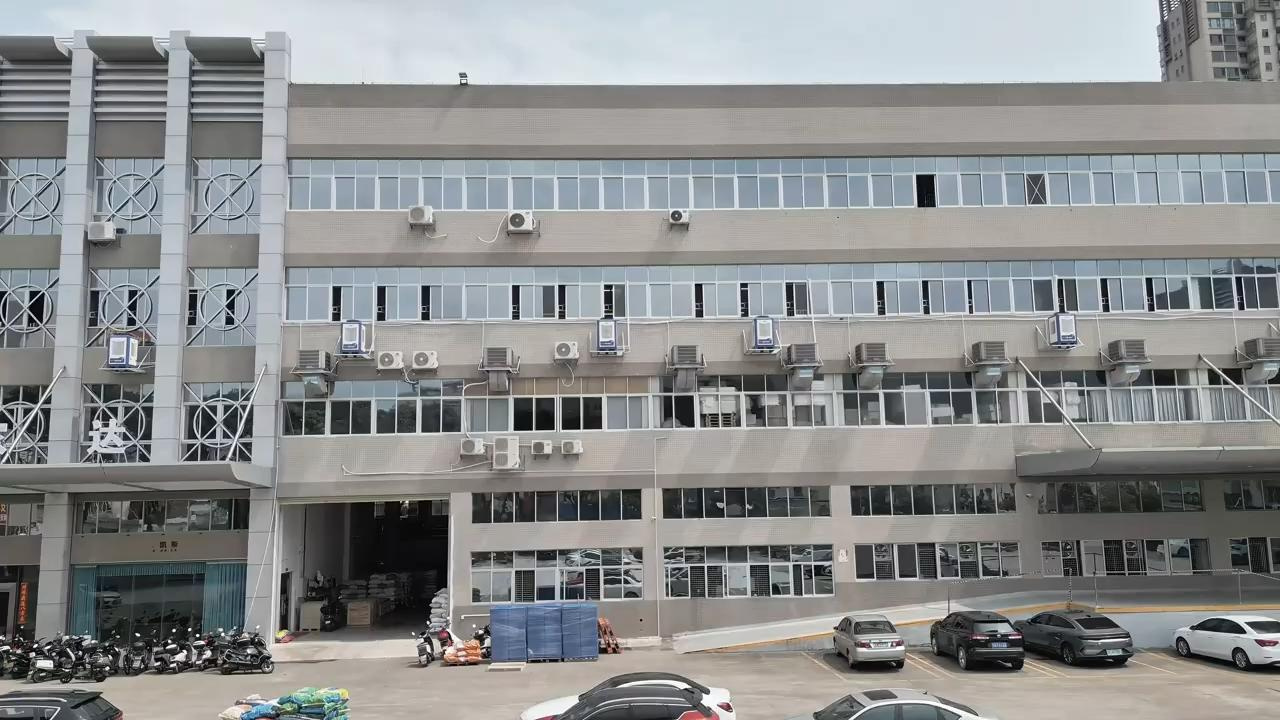
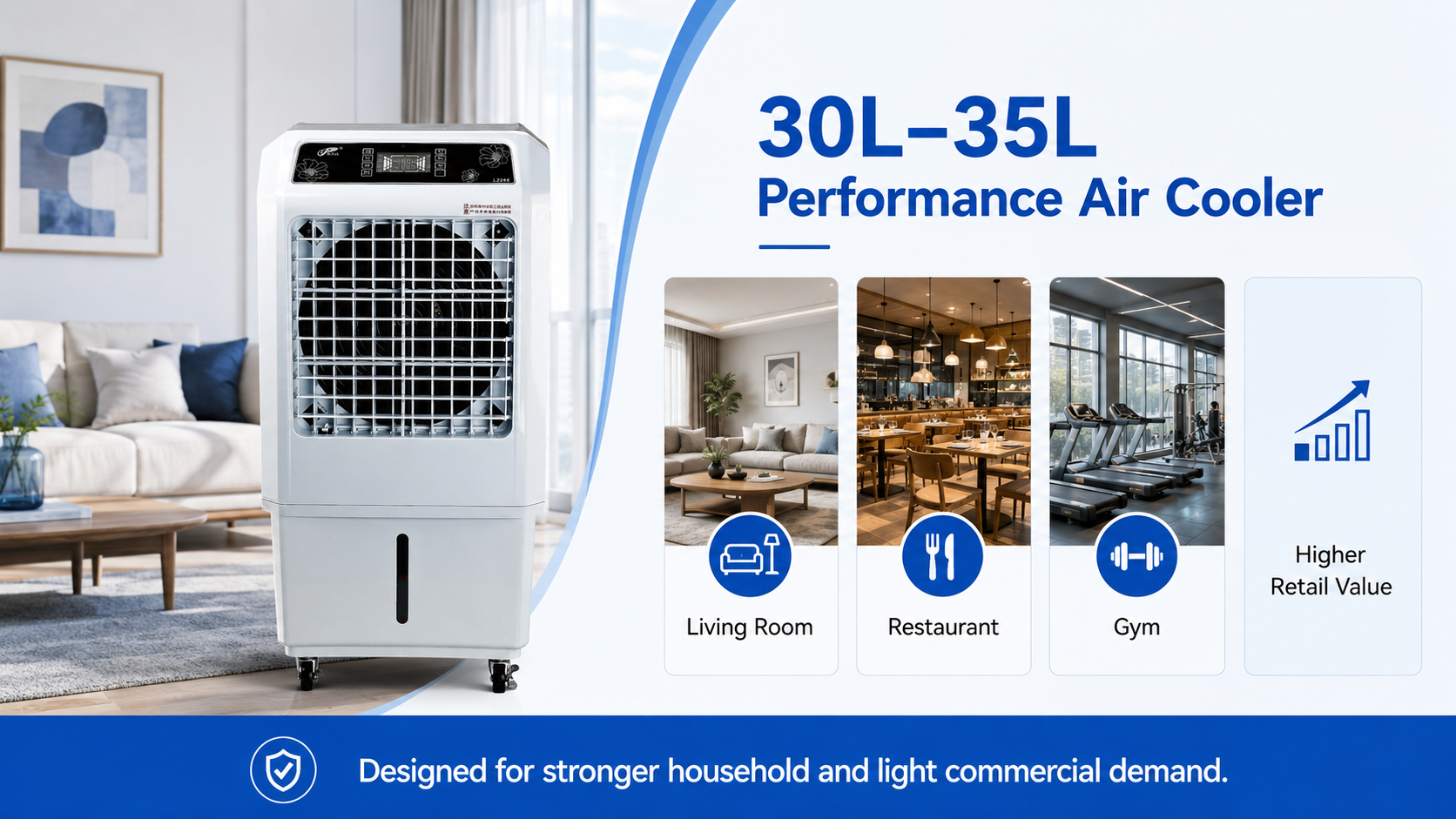
Air coolers are widely used in commercial spaces, open areas, workshops, retail spaces and some light commercial environments. This article explains the thermodynamic principle, core structure, material selection, standardized production process, quality control and testing methods of professional air coolers.
1. Core Working Principle of Air Coolers
1.1 Thermodynamic Principle: Evaporative Cooling
Air coolers follow the rule of direct evaporative cooling. When liquid water changes into water vapor, it absorbs latent heat from the surrounding air. This process converts sensible heat into latent heat, reducing air temperature while increasing humidity.
The cooling effect is closely related to ambient humidity. In dry air, evaporation is faster and the cooling effect is stronger. In high-humidity environments, the cooling performance will be lower.
1.2 Complete Working Process
The working process of an evaporative air cooler usually includes three steps.
First, the water pump transfers water from the tank to the water distributor above the cooling pad. The water is evenly sprayed onto the multi-layer corrugated cooling pad, forming a continuous water film.
Second, the fan system creates negative pressure inside the unit. Hot outside air is drawn through the wet cooling pad. When the hot air contacts the water film, part of the water evaporates and absorbs heat from the air.
Third, the cooled and filtered air is delivered into the indoor or open space by the fan. This provides cooling, ventilation and air exchange at the same time. Unlike traditional air conditioners, evaporative air coolers can work with doors and windows open.
1.3 Core Structure and Function
A professional air cooler normally includes the following main components:
Cooling Pad:
The cooling pad is the core heat exchange component. It is usually made from multi-layer corrugated fiber material, such as 5090 or 7090 cooling pad standards. The cross-corrugated structure increases surface area, improves water absorption and supports efficient evaporation.
Fan and Motor System:
The fan system often uses a copper motor and dynamically balanced fan blade. A stable motor helps reduce noise, improve airflow and extend service life.
Water Circulation System:
The water circulation module includes a water pump, water distributor, overflow pipe, drain pipe and filter. These parts ensure even water supply, stable cooling pad wetting and leakage-free operation.
Body and Electrical Control:
The air cooler body is usually made from engineering plastic such as ABS. The electrical control system may include water shortage protection, overheat protection, speed control, timer and automatic cleaning functions.
2. Professional Manufacturing Process of Air Coolers
Air cooler production follows modular design, standardized production and full-process quality control. The process normally includes material selection, component processing, complete machine assembly and final performance testing.
2.1 Core Material Selection
Cooling Pad Material:
High-quality cooling pads are usually made from reinforced fiber paper. The material is treated for mildew resistance, corrosion resistance and flame retardancy. Premium models may use antibacterial coating to extend service life.
Body Material:
The machine body is often made from ABS engineering plastic. It provides good impact resistance, corrosion resistance and stability in humid or dusty environments.
Electrical Components:
Motors, capacitors, wiring, switches and control boards should meet relevant safety requirements. A copper motor, waterproof control board and dry-run protected water pump help improve product reliability.
Auxiliary Materials:
Water pipes are usually made from thickened PVC hose. Sealing parts are made from silicone or nitrile rubber to prevent leakage and aging.
2.2 Core Component Processing
Cooling Pad Forming
The cooling pad production process usually includes paper sizing, drying, corrugation pressing, shaping, gluing, curing, slicing, trimming and odor removal.
Key process points include:
- Controlled corrugation height
- Stable corrugation angle
- Accurate cutting size
- Smooth edge trimming
- Good water absorption
- No strong odor
A well-formed cooling pad improves evaporation efficiency and reduces airflow resistance.
Fan System Manufacturing
The fan blade is commonly made from nylon and fiberglass materials. After injection molding, dynamic balance correction is required to ensure stable running and low noise.
The motor production process includes stator winding, varnish treatment, rotor processing and final assembly. Before leaving the factory, motors should pass no-load and load testing.
Water Circulation Components
The water pump should have stable flow, suitable head and dry-run protection. The water distributor should have evenly distributed holes to ensure full coverage of the cooling pad.
This section is especially important for buyers comparing air cooler water pump manufacturers, because the water pump directly affects the performance of the whole direct evaporative cooling system.
2.3 Mid-Section Buyer Search and Supplier Matching Keywords
For international buyers, choosing the right supplier is not only about product price. It is also about body quality, water system stability, electrical safety and production consistency.
When buyers search online, they may use terms such as air cooler manufacturer, air cooler factory, commercial air cooler manufacturer, swamp cooler manufacturers, air cooler body manufacturer, cooler body manufacturer, air cooler body wholesale suppliers and air cooler water pump manufacturers.
Some buyers may also search for air cooler manufacturers near me, air cooler company list, air cooler all company list, all company cooler price list, ac cooler companies, room cooler company, general company cooler or cooling fan company. However, a professional buyer should focus on whether the supplier can provide stable product design, reliable components, quality inspection and bulk order support.
For plastic body air coolers, buyers should pay attention to ABS material quality and mold precision. For buyers comparing an air cooler steel body manufacturer, it is important to understand whether the product is designed for household, commercial or industrial use, because steel body machines are often heavier and more suitable for special working environments.
For international buyers, choosing the right air cooler manufacturer is not only about comparing product price. Buyers also need to evaluate the air cooler factory, body material, water pump performance, electrical safety and production consistency.
During online sourcing, buyers may search for air cooler body manufacturer, cooler body manufacturer, air cooler body wholesale suppliers, air cooler water pump manufacturers, commercial air cooler manufacturer or swamp cooler manufacturers. Some buyers also compare a cooling fan company, room cooler company or ac cooler companies, but evaporative air coolers require a different production process because they use water circulation and a direct evaporative cooling system.
3. Standardized Complete Machine Assembly
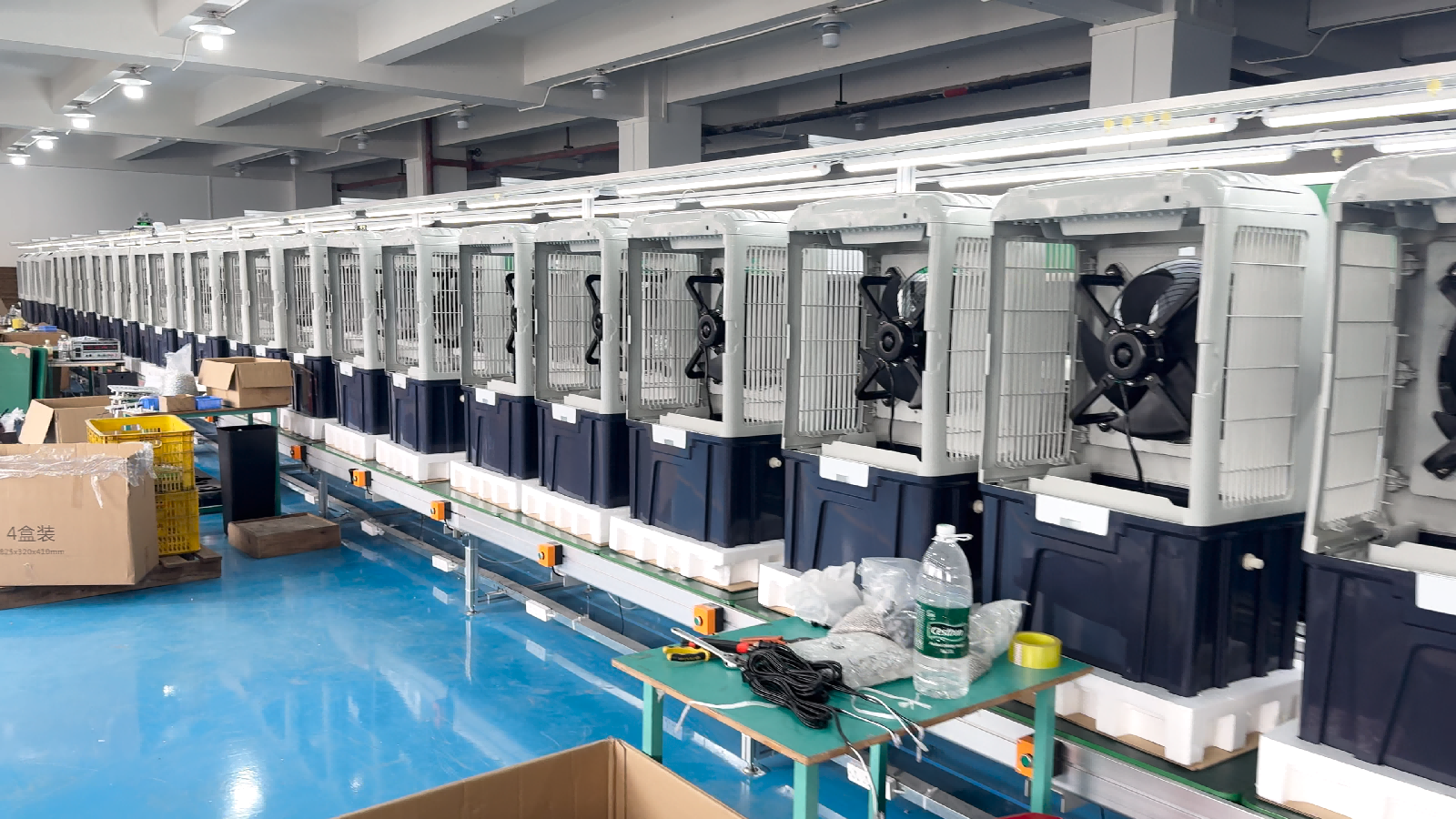
Professional air cooler production uses a modular assembly line to ensure stable quality and production efficiency.
3.1 Base and Water Tank Assembly
The base, water tank, water pump, drain valve, water level sensor and float valve are installed first. After assembly, the water tank should pass an airtightness or leakage test.
3.2 Cooling Pad Module Installation
The cooling pad is installed into the side or back frame of the air cooler. The sealing around the pad should be tight enough to prevent air bypass, which means air should pass through the wet pad instead of escaping through gaps.
3.3 Fan and Motor Installation
The motor is fixed with anti-vibration parts. The fan blade and air duct should be aligned properly. Standard torque control is used to prevent loose screws during transportation or operation.
3.4 Water Pipe Connection
The water pump is connected to the water distributor through the water pipe. A water flow test is required to confirm that the cooling pad can be fully and evenly wetted.
3.5 Electrical Control Integration
The wiring harness should be arranged neatly and fixed securely. Waterproof treatment and anti-mistake plug design help reduce the risk of short circuits caused by moisture.
3.6 Outer Body Assembly
The front panel, protective grille, air outlet, control panel and side covers are assembled in the final stage. The machine should have even gaps, no visible scratches and no body deformation.
4. Full-Process Quality Control and Testing
Before leaving the factory, professional air coolers should pass several reliability and safety tests.
4.1 Running Test
The machine should run continuously under standard working conditions to check motor stability, airflow consistency and overall performance.
4.2 Cooling Efficiency Test
Under rated conditions, the cooling performance should meet the design target. The cooling pad should have high evaporation efficiency and stable water absorption.
4.3 Electrical Safety Test
Electrical safety tests may include leakage current test, insulation withstand voltage test and grounding resistance test. These tests help ensure safe operation.
4.4 Waterproof and Splash Protection Test
Because air coolers use water circulation, waterproof protection around electrical parts is very important. The control board and wiring areas should be protected from splashing water.
4.5 Noise and Vibration Test
The fan blade, motor and air duct should be tested for noise and vibration. Low vibration helps extend service life and improve user comfort.
4.6 Mechanical Strength Test
The grille, wheels, handle and body structure should pass basic strength tests. The outer body should resist impact during normal transportation and use.
4.7 Water Shortage and Overload Protection Test
When the water level is too low, the water pump should stop or be protected in time. If the motor is overloaded, the protection system should prevent unsafe operation.
4.8 Simulated Working Condition Test
The product can also be tested under high temperature, humidity and dusty conditions to verify long-term reliability.
5. Technical Advantages of Professional Air Coolers
5.1 Energy Saving
Air coolers do not use compressors, so their power consumption is much lower than traditional air conditioners. They are suitable for spaces where ventilation and low operating cost are important.
5.2 Eco-Friendly and Healthy
Evaporative air coolers use water evaporation instead of refrigerant-based cooling. They can bring in fresh air, improve ventilation and reduce stuffy indoor air.
5.3 Reliable Structure
A modular structure makes the product easier to assemble, maintain and repair. Key components such as the motor, water pump, cooling pad and body structure determine the product’s service life.
5.4 Wide Application
Air coolers can be used in open or semi-open spaces, including workshops, farms, supermarkets, waiting areas, commercial spaces and some large indoor environments.
[Image 4: Application scene image showing air coolers used in commercial space, workshop, supermarket or open area]
6. Industry Standards and Future Trends
Professional air cooler production may follow standards related to household appliance safety, air filtration, evaporative cooling products and factory quality management. High-quality products may also support certifications such as ISO9001, CCC, CE or CB depending on the target market.
Future development trends include:
- Higher-efficiency cooling pad materials
- Energy-saving brushless DC motors
- Smart IoT control
- Integrated low-noise design
- Distributed fresh air cooling systems
- Better water-saving and self-cleaning technology
These improvements will continue to make air coolers more efficient, comfortable and intelligent.
Conclusion
Air coolers use natural evaporative cooling as the core principle. Through the combination of material science, airflow design, water circulation, electrical control and precision manufacturing, they provide an energy-saving and environmentally friendly cooling solution.
From material selection to complete machine testing, every process affects the final performance and service life of the product. A professional air cooler manufacturer should not only provide competitive pricing, but also stable production, strict quality control and reliable after-sales support.
For buyers searching for an air cooler factory, air cooler body manufacturer, cooler body manufacturer, air cooler body wholesale suppliers, commercial air cooler manufacturer, swamp cooler manufacturers, room cooler company, ac cooler companies, cooling fan company, general company cooler, air cooler company list, air cooler all company list, all company cooler price list or air cooler manufacturers near me, the key is to choose a supplier that can match the correct product type with the correct application.
WOSIDE focuses on air cooler manufacturing, product development and OEM/ODM support. Whether buyers need body structure evaluation, water pump matching, cooling pad performance, packaging support or bulk production, a complete manufacturing and inspection process helps ensure stable product quality from sample confirmation to mass production.
Some buyers may also search for air cooler manufacturers near me, air cooler company list, air cooler all company list, all company cooler price list or general company cooler when comparing suppliers online. However, for bulk purchasing, the key is not only finding a list of companies, but choosing a reliable air cooler manufacturer with stable production, proper testing and OEM/ODM support.
For buyers comparing an air cooler steel body manufacturer, it is also important to confirm the final application. Steel body air coolers are usually more suitable for heavy-duty or special environments, while many household and light commercial air coolers use plastic body structures for better mobility, appearance and retail suitability.
Share This Article

Written by : Jamie Chen
post contents
Follow Us
Latest Articles
5 October, 2026
5 October, 2026